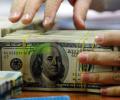
The UN Conference on Trade and Development (UNCTAD) said in a report on Monday that a lower but positive economic growth in India in the post-Covid-19 pandemic period and India's large market will continue to attract market-seeking investments to the country. The World Investment Report 2020 by UNCTAD said that India was the 9th largest recipient of FDI in 2019, with 51 billion dollars of inflows during the year, an increase from the 42 billion dollars of FDI received in 2018, when India ranked 12 among the top 20 host economies in the world.

The ministry's year-end review is silent on the continued occupation by Chinese troops of territory that India has always claimed and patrolled.

MSI chairman R C Bhargava said auto sector would like to see GST benefits linked to greener/cleaner cars. The government gave tax cut on EVs but hybrid should be given duty cut. There should be tax cut on CNG vehicles.

The online pharmacy market, which was worth about $512 million in 2018, is growing at a CAGR of 63 per cent and is expected to hit overall revenues of over $3.6 billion by 2022.

Profitability and cash reserves have halved since the global financial crisis.

As a nationwide strike of trade unions hit banking and other services on Wednesday, business chambers pegged the loss to the economy at a staggering Rs 25,000 crore and said such "disruptive" actions can hit India's image as an attractive business destination.

In a bull-case scenario it sees the Sensex at 61,000 levels, while it's bear case scenario pegs the Sensex at 41,000 levels by December 2021.

The companies that have seen sharp erosion of market wealth include YES Bank, Indiabulls Housing Finance, Zee Entertainment, Vodafone Idea, and Bharat Heavy Electricals.

The global ratings agency keeps India's sovereign rating unchanged at 'BBB-' with stable outlook

In fact, no other recent Union Budget has held so much significance for the Indian economy as the one to be presented in about six weeks from now, notes A K Bhattacharya.
'We can only hope that the government has finally 'got it' and will stay focused on improving productivity, demand, and governance,' says Debashis Basu.

In the broader market, the S&P BSE Midcap and the S&P BSE Smallcap indices gained 0.5% and 0.4%, respectively.

Investor wealth zoomed over Rs 10.48 lakh crore in two days as the Budget-driven market euphoria continued to charge bulls on Tuesday.
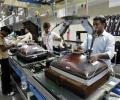
There is a new energy in 2015 and a new breed of young, ambitious innovators and entrepreneurs who are coming up with creative solutions to many of India's problems, says Mallika Kapur.

Think organic food, affordable homes, artificial intelligence, suggests Prof Manmeet Barve.

Employees of some top Indian companies were in for a pleasant surprise when they received a mail from their HR team announcing a hike in salaries and bonuses. Led by IT firms and start-ups, HR managers say that while some have offered cash and stock options, others are in a wait-and-watch mode and add the trend will pick up in other sectors. For example, IT giant Cognizant - which had an attrition rate of 19 per cent in the December quarter - has established a $30-million employee retention fund in order to bring down the high attrition rate.

Together, the top 10 business groups reported a pre-tax loss of Rs 19,342 crore during the January-March 2020 quarter, as against a profit before tax of around Rs 48,500 crore in the year-ago period and Rs 39,600 crore during the December quarter. While Vedanta was the worst hit. others included Aditya Birla, Bharti, Adani, Mahindra, and Tata.

Over the past one-and-half years, the number of stocks trading below their respective face value has increased 29 per cent after a sharp correction in stocks of small-cap companies.

Underweight on the sector since January amid concerns over growth prospects; no early reversal seen
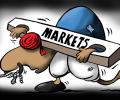
Market cap of government companies has remained unchanged in the past 8 years.

Sensex plunges 322.39 points to over 1-month closing low of 27,797.01; Nifty tumbles 97.55 points to 8,340.70.

Byju's, says Anita Kishore, has given the founders of the businesses it has acquired the independence to operate separately and maintain their core culture.

ONGC, Sesa Sterlite, Tata Steel, RIL and HDFC emerged as the biggest losers

There is positive correlation between crude oil prices and Indian equities and investors can expect more upside after the recent rally in Brent crude price.

Prime Minister Narendra Modi on Wednesday called for focus on 'repair and prepare' as the nation emerges out of a devastating pandemic. "Over the past year, we have witnessed a lot of disruption in different sectors. Much of it is still there. Yet, disruption does not have to mean despair," he said at VivaTech Summit. "Instead, we must keep the focus on the twin foundations of repair and prepare," he said referring to the need to augment healthcare infrastructure in the country as well as prop up the economy.

HR Guru Mayank Rautela offers practical advice.

As India emerges from the COVID-19 crisis, the ninth budget under the Modi government, including an interim one, is widely expected to focus on boosting spending on job creation and rural development, generous allocations for development schemes, putting more money in the hands of the average taxpayer and easing rules to attract foreign investments.

Of the 3.9 million the sector employs, HR experts say at least 100,000 are likely to lose their jobs by the end of this financial year. Ayan Pramanik and Raghu Krishnan report.

Omkeshwar Singh, Head, Rank MF, a mutual fund investment platform, answers your queries.
About 50 per cent of the accounts that availed of the EMI moratorium amid the pandemic, which made things worse in an already slowing economy, are expected to be restructured, and of these accounts that would undergo restructuring, one-third, or Rs 6-9 trillion, could turn into NPAs.

Spiralling prices pinched the pocket of consumer as edible oil, fuel and many other commodities turned dearer this year amid pandemic-induced disruptions but the inflationary pressure is anticipated to ease, though marginally, in the coming months. As consumers, at retail as well as wholesale levels, are willy-nilly learning to live with the new normal of curbs to contain the spread of coronavirus infections, experts are of the view that elevated inflation is likely to stay longer. After dealing with the devastating blows from the second COVID wave, especially during the April-June period, the economy is well on the revival path but the emergence of Omicron might unsettle the recovery trajectory in the short term.

The credibility of India in the eyes of foreign investors has also relatively gone up, with China's blunders in this crisis.

A combination of externalities such as global trade wars and slowing growth, continuing glitches in accessing offsets under the GST regime, which has created a liquidity crunch for smaller exporters, and the growing competitiveness of smaller countries are causing the slowdown.

The market breadth in BSE remains positive with 1,554 shares advancing and 1,196 shares declining.

Pegging the cost of the covid-19 lockdown at USD 120 billion (approximately Rs 9 lakh crores) or 4 per cent of the GDP, analysts on Wednesday sharply cut their growth estimates and stressed on the need to announce an economic package. The Reserve Bank of India (RBI), which is scheduled to announce its first bi-monthly policy review on April 3, is set to deliver a deep rate cuts and it should also be assumed that the fiscal deficit targets will be breached, analysts said.

Even at early stage, start-ups are raising more money faster owing to the rise of a lot of specialised early-stage VCs and emergence of seed-stage programmes.

The bigger worry is that the miss for FY19 is likely to be significant even after assuming macro factors such as crude oil prices, rupee, input costs, and interest rates, do not worsen from the current levels, reports Vishal Chhabria.

Chaos in Parliament threw a spanner in the government's efforts to revive the economy and kick-start reforms.

Divestment in BPCL, SCI, Concor, NEEPCO, and THDC would help the Centre keep its fiscal deficit in check in the wake of subdued tax revenues and a Rs 1.45-trillion hit for the exchequer from corporation rate cuts.

'We are going to have a recession this year, maybe next year too...'
